|
|

|
|
EVERYTHING YOU WANT TO KNOW ABOUT PHOBIA BUT WERE AFRAID TO ASK!
The word 'Phobia' is derived from the Greek 'Phobos' meaning 'aversion' or 'morbid fear'.
A phobia is an intense fear of something that, in reality, poses little or no actual danger.
Common phobias and fears include closed in places, heights, spiders and other insects, flying, snakes,
public speaking and needles. However, we can develop phobias of virtually anything.
Almost everyone has an irrational fear or two, of exams for example, or your annual dental check up. For most people,
these fears are minor. But when fears become so severe that they cause a heightened level of anxiety which interferes
with your normal life, they're called phobias.
The good news is that phobias can be managed and cured. Phobias are, for the most part, learnt and can therefore be unlearnt.
Self help strategies and professional therapy can help you overcome your fears and start living the life you want.
Phobias are the most common type of anxiety disorder. It's estimated that around 10 million people in the UK have a phobia.
They can affect anyone, regardless of age, sex and social background. There are over 1000 classified phobias (to date)
and many you probably have never heard of but are very real and troubling for those afflicted.
For example, Nomophobia is the fear of being out of service range, out of charge or out of credit for your mobile phone.
Plutophobia is the fear of money, Trypophobia is the fear of tiny holes, Spectrophobia is the fear of mirrors and your own reflection.
If you have a phobia, you probably realise that your fear is unreasonable, yet you still can't control your feelings.
Just thinking about the feared object or situation usually results in an aroused state of anxiety. And when you're actually
exposed to the thing or event you fear, the terror is automatic and unrelentless.
The experience is so overwhelming that you will go to great lengths to avoid it - inconveniencing yourself or even
changing your lifestyle. If you have claustrophobia, for example, you'll take the stairs instead of the lift to your office on the 4th floor.
If you have a fear of heights, you might drive an extra 20 miles in order to avoid a tall bridge.
Understanding your phobia is the first step to overcoming it. It's important to know that phobias are common.
(Having a phobia doesn't mean you're crazy!) It also helps to know that phobias are highly treatable.
You can overcome your anxiety and fear, no matter how out of control it feels.
It's rational to feel anxious when flying through turbulence or taking off during a storm.
It's rational to experience butterflies peering down from the top of a skyscraper.
It's rational to be nervous when you see a large Rottweiller approaching you.
With any Phobia there are two common cognitive (thinking) distortions
Emotional signs and symptoms of a phobia include
Treatment for phobias
Although phobias are common, they don't always cause considerable distress or significantly disrupt your life. For example, if you have a snake phobia,
it may cause no problems in your everyday activities if you live in a city where you are not likely to run into one. On the other hand, if you have a
severe phobia of crowded spaces, living in a big city would pose a problem.
If your phobia doesn't really impact your life that much, it's probably nothing to be concerned about. But if avoidance of the object, activity, or
situation that triggers your phobia interferes with your normal functioning, or keeps you from doing things you would otherwise enjoy, it's time to seek help.
When it comes to treating phobias, self help strategies and therapy can both be effective.
What's best for you depends on a number of factors, including the severity of your phobia, and the amount of support you need.
As a general rule, self help is always worth a try. The more you can do for yourself, the more in control you'll feel - which goes a long way when it
comes to phobias and fears. However, if your phobia is so severe that it triggers panic attacks or uncontrollable anxiety, you may want to get additional support.
The good news is that therapy for phobias has a great track record. Not only does it work extremely well, but you tend to see results very quickly,
sometimes in as a little as three to four sessions. There are a distinct number of routes available to the therapist including Cognitive Behavioural Therapy (CBT),
systematic de sensitisation, Hypnotherapy and Psychotherapy. Your therapist will attempt to discover with you what is referred to as the Initial Sensitising Event (ISE).
This is the root cause of the phobia and it may well lie in a past traumatic event or it may be a learned response
(e.g. your mother was afraid of bees [Apiphobia] and so you learned to fear them).
Your therapist will work with you to understand why your phobia continues or is maintained. This involves challenging thoughts, beliefs and actions.
However, support doesn't always have to come in the guise of a professional therapist. Just having someone to hold your hand or stand by your side as you
face your fears can be extraordinarily helpful.
It's only natural to want to avoid the thing or situation you fear. But when it comes to conquering phobias, facing your fears is the key.
While avoidance may make you feel better in the short term, it prevents you from learning that your phobia may not be as frightening or overwhelming as you think.
The fear response is a learned response and as such, it can be unlearned.
The only mistake you can make is not asking for help. Don't suffer.
Why not contact me?

Difference between rational fear and phobia
A Phobia of flying (Aerophobia) prevents you from attending your best friends island wedding because you'd have to fly.
A phobia of heights (Acrophobia) means you have to turn down a great job offer because it's on the tenth floor.
A Phobia of dogs (Cynophobia) prevents you from enjoying the park because you might meet a dog.
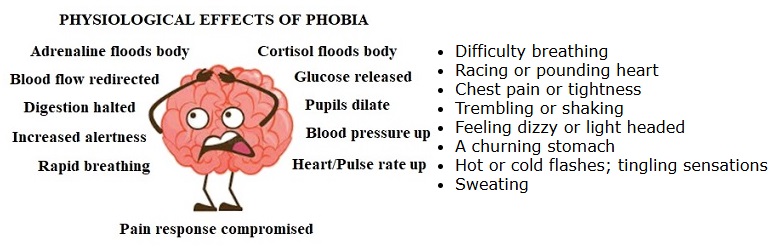
The symptoms of a phobia can range from mild feelings of apprehension and anxiety to a full-blown panic attack.
Typically, the closer you are to the thing you're afraid of, the greater your fear will be. Your fear will also
be higher if getting away is difficult.
 Avoidance means that you never get the chance to learn how to cope with your fears and experience control over the situation.
As a result, the phobia becomes increasingly scarier and more daunting in your mind.
In order to break this cycle, exposure therapy is used to enable you to face your fears starting with something that is easy and then, building up to harder situations.
Regular practice will gradually reduce your fears. Yes, it may be difficult to start with but at present, you're getting short term relief from avoiding your fear and
this is not a long term solution. Facing your fears may provoke short term anxiety that provides long lasting relief from your phobia.
Avoidance means that you never get the chance to learn how to cope with your fears and experience control over the situation.
As a result, the phobia becomes increasingly scarier and more daunting in your mind.
In order to break this cycle, exposure therapy is used to enable you to face your fears starting with something that is easy and then, building up to harder situations.
Regular practice will gradually reduce your fears. Yes, it may be difficult to start with but at present, you're getting short term relief from avoiding your fear and
this is not a long term solution. Facing your fears may provoke short term anxiety that provides long lasting relief from your phobia.
Ian McLeod CHP(NC), MNSHP&M, DPLT
