|
|

|
|



WHAT IS THERAPY?
Therapy is all about you...... Daunting, right?
Yes, but it's also your precious time dedicated to struggles you feel stuck with.
Misconceptions about Therapy
A common prejudice is: 'Therapy is for crazy people'.
Ignoring pain or chaos can have a real knock-on effect on your life, and sometimes therapy is the best way to get through this.
Or perhaps you feel completely on your own, stuck or 'hopeless' in your situation. Maybe you don't want to burden your pain on
others, or you feel everything is too unbearable altogether for it to be resolved. This is not crazy - it's life being difficult.
Therapists exist to treat this (and of course all the long-term mental health conditions too).
Another misconception about therapy is that it's going to alleviate your pain and solve your problems quickly.
Therapy is often not a quick-fix. Therapy can be uncomfortable, particularly if you don't like to talk about yourself.
The Therapist is there to guide you with your internal journey, but they need your dedication and effort to look your
innermost problems in the eyes, and to dive right through them. It's a hugely brave thing to do, but the benefits you'll reap once you're on the 'other side'
of your struggles will be massive and long-lasting.
THERAPY Vs COUNSELLING
Counselling
Counselling is one or series of conversations between a Counsellor and a Client. It's sometimes referred to as 'talk therapy'
and addresses specific problems experienced today in a solutions-focused way. The conversations are usually talked about in
the present tense and don't go too deep into the past as a way of dealing with current problems. Counsellors don't create the
solutions for the Client - they have more of a co-creating role where they mirror back the responses from the Client to reach
mutual conclusions about the best steps to take for the Client.
Therapy
Do I need Therapy?
It's not easy to know if you need Therapy or not. The mind is always elusive and perhaps you stick to the thought that you can do this on your own.
'I'm strong enough to deal with this', 'if others have gone through this alone, I can too', 'they're going to think I'm crazy if they find out' and
'therapy just isn't for me' are just some of the beliefs many people in need of therapy stick to.
Thinking these things are not necessarily signs you definitely need therapy, but they are indicators you know external help could be useful, but think
that seeing it through will be bad.
Therapy is not an overnight solution to issues. It takes your dedication and commitment to cooperate with the Therapist's methods
and suggestions before you can reach a point of equilibrium in your life. The Client is an active participant in therapy
and improvement comes only with their own efforts to cooperate with the Therapist.
What have you got to lose? The only mistake you can make is not asking for help.
Why not contact me?
Sure, the internet might give you answers to work with, but it doesn't listen to you and analyse you like a real person can.
It doesn't comment on the things you say, and it doesn't experience the unconscious behaviours you're expressing right now.
A Therapist is trained to do all this.
More specifically, therapy is the meeting of a Therapist and Client in a safe and confidential environment with the
goal of resolving problematic beliefs, behaviours, feelings, relationship issues, or negative physical responses.
Friends, family, partners or others may not know how to begin alleviating your painful situation, whatever it may be,
or you might be completely alone with it, and that's where a knowledgeable professional can help.
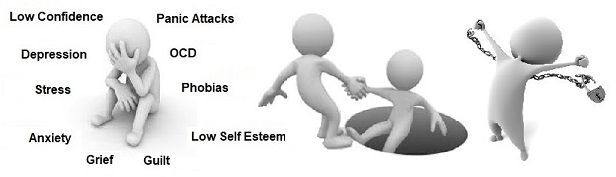
I cannot emphasise enough how big a misconception this is. First, using the term 'crazy' is offensive to all people suffering mental health
conditions, and it contributes to the stigma attached to it, making it even harder to seek help.
Second, most people who seek therapy are normal people who experience a rough patch in life. You can think about help-seeking as a
healthy coping mechanism to deal with difficult situations.
You might think Therapists have all the answers, and you could be either waiting for or dreading the moment they'll tear your psyche open
and reveal the root cause of all your problems. Yes, they're experts in what they do, but they're not psychic mind readers.
In most cases, you'll be undergoing an internal process where talking about your problems is part of getting better AND giving the
conversation between yourself and the Therapist a helpful direction.
There are many types of therapies however, and some emphasise your own talking more than others who emphasise the therapist's analyses or
suggestions more. The type of therapy that works best for a person depends on the psychological issues and also what works best for the
struggling individual. There's no perfect solution that's suitable for all people.

Psychotherapy - in short: Therapy - is also one to many conversation sessions, but with a Hypnotherapist/Psychotherapist instead. The
approach here is to dig deeper into the Client's problems than counselling does. General life patterns, the past, and the relation
between things in the Client's life may all be considered and dealt with as part of the psychological healing process. Therapy deals
with current issues but also more permanent issues experienced persistently by the Client. Hypnotherapy may be used in a Therapy session to support and assist the
Client in moving towards a future solution.
Despite the differences between the two, it can sometimes be hard to distinguish them because there are overlaps between Therapists and Counsellors techniques.
However, an understanding of these basic differences will make it easier to choose an appropriate practitioner for the Client in need of the best possible help.
People who choose therapy have very different reasons for following through with it. Often, things have been building up inside them until a
saturation point that prompts them to seek help. Sometimes, others have suggested therapy might be the way to go, because they are worried
about you. Someone could choose therapy because they know they're not reacting rationally to something and instinctively knows it needs to be addressed.
Maybe a person survived a rough patch in life, be well aware of the seriousness of it, still be okay psychologically, but know that they need to
process it properly to prevent a breakdown later on. Someone could seek help if they just can't figure out an answer to their problems and feel
they're banging their head against a wall. Or they might feel they're in such pain, chaos or confusion that someone else needs to help them out of it.
There are so many reasons that people seek help from Therapists, and these are just a few of them.
It's hard to predict how long it will take someone to get to a better state in life, but many people find that
2-3 months of regular sessions are enough to get better. It could also just be a matter of a few sessions or
it could be years. It all depends on the severity of your condition and your commitment to work on it.
Every Client is unique so beware of Therapists offering a set number of sessions for a particular issue.
Ian McLeod CHP(NC), MNSHP&M, DPLT
